Peptides of London
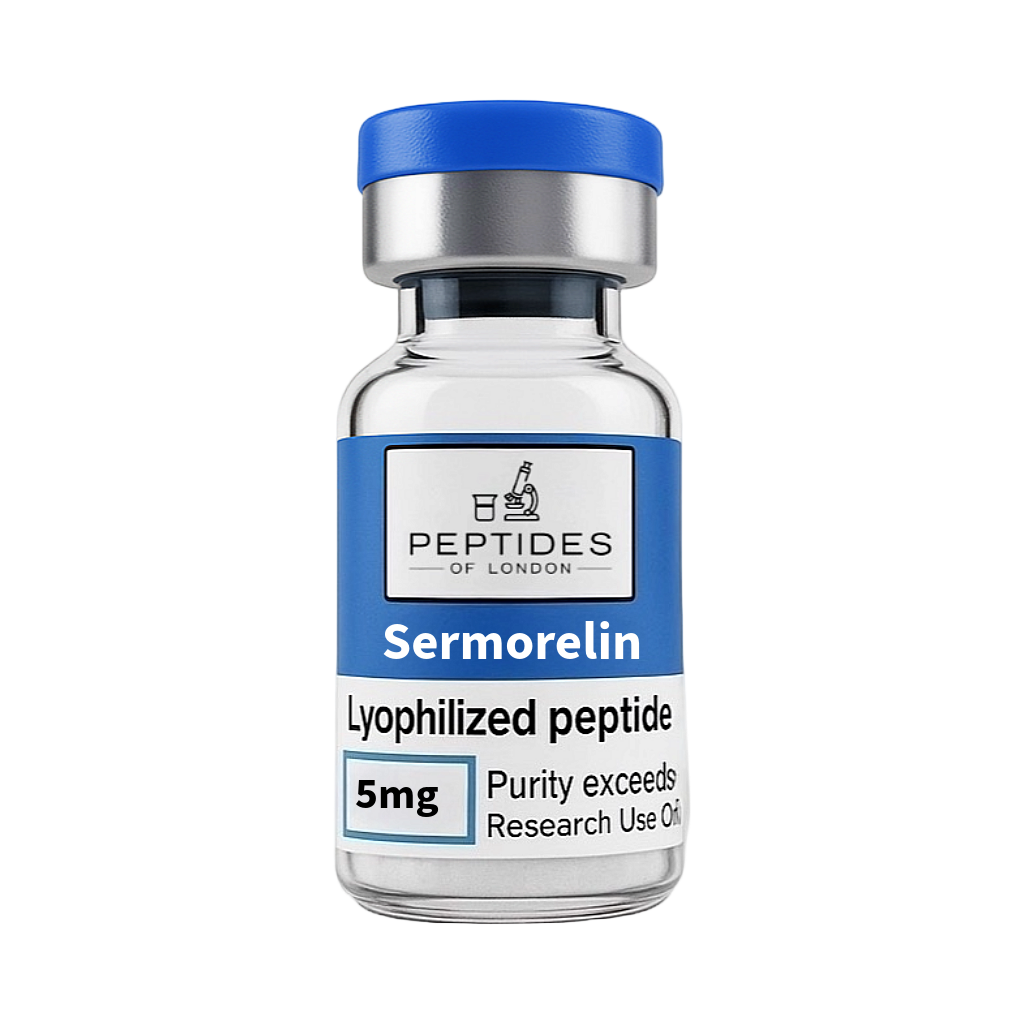
Sermorelin (GRF 1-29 ) 5mg
Couldn't load pickup availability
Sermorelin 5mg – Ultra-Pure GHRH(1-29) Peptide for Advanced Research
Sermorelin, also known as Sermorelin Acetate or GRF(1-29) amide, is a synthetic peptide corresponding to the biologically active N-terminal 29-amino-acid fragment of growth hormone–releasing hormone (GHRH). Within controlled research environments, Sermorelin is widely utilised as a GHRH analogue for the investigation of somatotropic axis signalling, pituitary receptor activation, and pulsatile growth hormone release mechanisms in experimental models.
Originally developed as the shortest fully functional fragment of native GHRH, Sermorelin has been extensively characterised in laboratory studies focused on growth-hormone secretagogue biology, receptor–ligand dynamics, and upstream regulation of GH-associated signalling pathways.
⸻
⚙️
Peptide Specifications
• Synonyms: Sermorelin, Sermorelin Acetate, GRF(1-29), GHRH(1-29) Amide, Growth Hormone-Releasing Factor (1–29)
• Sequence: Tyr-Ala-Asp-Ala-Ile-Phe-Thr-Asn-Ser-Tyr-Arg-Lys-Val-Leu-Gly-Gln-Leu-Ser-Ala-Arg-Lys-Leu-Leu-Gln-Asp-Ile-Met-Ser-Arg-NH₂
• Molecular Formula: C₁₄₉H₂₄₆N₄₄O₄₂S
• Molecular Weight: ~3357.9 g/mol
• Appearance: White lyophilised powder
• Purity: ≥99%+ (HPLC verified)
• Solubility: Sterile water or dilute acetic acid (lab use only)
• Storage: 2–8 °C (short term) / –20 °C (long term)
• Packaging: 5mg glass research vial, free from additives
⸻
🧪
Scientific Insight & Synergistic Research
• GHRH Receptor & Somatotropic Axis Studies: Commonly employed as a direct GHRH receptor agonist in experimental systems evaluating upstream control of GH-related signalling cascades
• Pulsatile Secretion & Feedback Modelling: Widely used in laboratory models investigating pulsatile secretion dynamics, negative-feedback regulation, and somatostatin–GHRH interactions
• Comparative Secretagogue Research: Frequently explored alongside other GH-axis modulators such as CJC-1295 variants, GHRP analogues, and Ipamorelin in comparative and combination pathway studies
• Structure–Function Analysis: Utilised as the minimal fully active GHRH fragment for examining receptor binding efficiency, signal transduction, and N-terminal residue contributions
⸻
Published literature continues to support the role of Sermorelin (GHRH 1-29) as a foundational research peptide for investigations into growth hormone–releasing hormone biology, pituitary signalling networks, and GH-axis regulatory mechanisms.
Share